Showing posts with label Albert Einstein. Show all posts

Thursday, July 9, 2026

Persons cited in Populscience

Poisson distribution of person names

I enjoy compiling statistics on many things. Naturally, I also do it for this blog. One of the statistics I often compile is that of the names of people (scientists or otherwise) most frequently mentioned in the blog, which now has 564 posts. I presented such a table in January 2024, when 449 articles had been published, in the post titled Ten years of Divulciencia-Populscience, and I think it's time to update it. Here is the corresponding table, showing 40 people who have been mentioned at least 10 times.


Thursday, January 15, 2026

The future is not written

In several posts in this blog, I've discussed determinism, always from a critical perspective. For example, in a post entitled The debacle of determinism, I mentioned the three devastating attacks suffered by determinism during the 20th century: Heisenberg's uncertainty principle (although it would be better to use the name Heisenberg originally proposed: the indeterminacy principle); chaos theory; and the Copenhagen interpretation of quantum mechanics.

Chapter 7 of Kevin Mitchell's book Free Agents, titled, like this post, The future is not written, analyzes and refutes determinism. However, it doesn't discuss just one type of determinism, but three, refuting them one after another in successive chapters. What are these three types of determinism?

1.      Physical predeterminism: the idea that only one possible timeline exists. In other words, that the future is entirely determined by the past; that the entire history of the universe is predetermined from the beginning; that nothing that happens could have happened otherwise.

Thursday, June 26, 2025

Can density be infinite?

First photo
of a black hole

Einstein’s general theory of relativity allows for the existence of objects with infinite density (singularities). There are two types:

1.      Black holes, accumulations of matter in a null volume, either at the center of a galaxy, or as the result of a supernova explosion.

2.      The universe, at its initial moment (the Big Bang).

A star like the sun is in equilibrium because the gravitational attraction, which tends to make it contract, is equal to the expansion caused by the nuclear reactions taking place inside the star. When a star much larger than the sun exhausts its nuclear fuel (first hydrogen, then helium, then other elements), as there are no longer nuclear reactions to stop the contraction, the star implodes. When the implosion rebounds, the star throws large quantities of matter into space: a supernova explosion, which for some time makes the star brighter than a whole galaxy. But there is always a remainder of matter, which gives rise to a new type of object.

Thursday, May 15, 2025

Phantoms in the Universe?

The Standard Cosmological Model has introduced in physics two new concepts that didn't exist before:

  • Dark matter: It seems to be five times more abundant than ordinary matter, but we don't know what it is, what it's made of. We only know that it appears to be affected by gravity, and so far, its existence has been concluded in two different ways: a) By analyzing the rotational motion of galaxies, which seems to require that there is more mass in them than what we can see. b) By studying the cosmic microwave background radiation, which has served as the basis for adjusting the standard cosmological model.
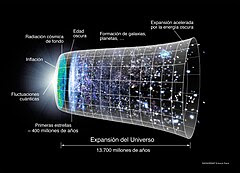
  • Dark energy: We have no idea what it is. Some speak of a fifth fundamental interaction (or force), the quintessence, which would join the four we know: gravitational, electromagnetic, strong, and weak. Others offer different explanations, none of which have received experimental confirmation. The hypothesis of its existence is supported by two observations: a) Analyzing the expansion rate of the universe, after the 1998 discovery that this rate is accelerating. b) By studying the cosmic microwave background radiation, which has served as the basis for adjusting the standard cosmological model.

Thursday, March 6, 2025

Changes in the Scientific Paradigm

Thomas Kuhn

As Thomas Kuhn pointed out, from time to time there are shifts in the scientific paradigm that cause sharp deviations in the direction of research. These shifts can occur in any of the sciences. Here are some important historical examples:

Puerperal fever was for centuries the leading cause of death in women giving birth. In 1795, the Scottish obstetrician Alexander Gordon claimed that the disease was transmitted by doctors and midwives. In 1842, the English physician Thomas Watson, known for his description of the aortic pulse, recommended that doctors wash their hands with diluted lye before attending a birth. And in 1847, the Austrian physician Ignaz Semmelweis advised the same, based on data showing that the incidence of puerperal fever was higher in hospitals than in births taking place at home, and higher among women in labor attended by doctors than by midwives. Semmelweis' proposals were violently rejected by contemporary physicians, who were outraged by the idea of ​​being blamed for infections caused by themselves, to the point that Semmelweis was committed to an asylum where he only survived two weeks. His death is believed to have been the result of a beating by the asylum guards when Semmelweis, who was 47 years old, tried to escape. His proposals were confirmed by the discovery of the germ theory of infectious diseases by Louis Pasteur, according to which diseases are caused by microorganisms, and not by miasmas transmitted by air, as previously believed. This caused an abrupt change in the scientific paradigm applied to medicine.

Thursday, March 28, 2024

The mystery of the cosmological constant

Alexander Friedmann
(Александр Фридман)

This post completes a previous post with a similar title:

The problem of the cosmological constant.

First of all, we should define three different concepts that could be closely related:

  1. Vacuum energy: due to the constant appearance of pairs of particles and antiparticles that immediately mutually disintegrate, so they are undetectable through direct experimentation. Their appearance is a consequence of the uncertainty principle: ΔΔt<ħ/2, which implies that a particle with energy ΔE can appear spontaneously during a time Δt<ħ/(2ΔE), which is smaller for larger ΔE. Thus, a virtual electron would last less than 4×10-21 seconds. A proton, whose mass is 1837 times greater, would last 1837 times less. By applying quantum field theory to all the known particles, the energy of the vacuum can be estimated.
  2. The cosmological constant: introduced by Einstein in his cosmological equation, which in the format devised by Alexander Friedman is expressed as follows: The symbol Λ is the cosmological constant. Einstein proposed a negative value, to compensate for a cosmic expansion, in which he initially did not believe. Today it is thought to be positive, which would explain the accelerated expansion of the universe discovered in 1998.
  1. Dark energy: an unknown agent that would cause the accelerated expansion of the universe.

Thursday, March 23, 2023

Can we see the beginning of the universe?

As I often point out in these posts, the mainstream media, and sometimes high-profile popular magazines as well, may not be quite accurate when they announce science news. With headlines, especially, they tend to make major mistakes, because they try to make them as appealing as possible, which means that they also suffer from the greatest distortions.

Let us look at a recent news. This is the headline:

Scientists figured out how to see the beginning of time

Wednesday, June 1, 2022

Do black holes have hair?

Black holes are strange objects. They are accumulations of extremely compact matter, which exerts such huge gravity that at less than a certain distance (the event horizon) nothing can escape their attraction, not even light. Hence their name.

The existence of black holes had been predicted in the 18th century by the English geologist John Michell and the French astronomer Laplace. At that time nobody paid attention, but from 1915, when Einstein formulated the theory of General Relativity, the interest in these mysterious objects grew. It was soon concluded that when a massive star exhausted its ability to produce nuclear fusion reactions, no force of nature would be able to overcome the gravitational pull of the remaining matter, resulting in a black hole. But for a long time there were doubts about their real existence, for the theory seemed to predict that the matter located inside a black hole would occupy a zero volume and therefore would have an infinite density. As physicists usually suspect that infinity is a mathematical concept that cannot happen in real life, there were two possibilities: either black holes do not exist, or Einstein's theory would have to be modified so that they wouldn’t have an infinite density.

Wednesday, May 25, 2022

The most surprising scientific failures

Lord Kelvin

The magazine Science News has published an article entitled Here are the 10 ten times scientific imagination failed, either because it fell short, or because it went too far, with respect to what it was logical to imagine. The study begins by quoting Albert Einstein:

Imagination is more important than knowledge... Imagination embraces the entire world, stimulating progress.

Tom Siegfried, author of the article, adds:

And yet while sometimes spectacularly successful, imagination has also frequently failed in ways that retard the revealing of nature’s secrets. Some minds, it seems, are simply incapable of imagining that there’s more to reality than what they already know.

Then he specifies one by one the 10 cases where, according to him, the imagination of scientists fell short or went too far. This is the list, from most to least important (according to Siegfried):

Wednesday, December 8, 2021

My 10 Favorite Scientific Discoveries of the 20th Century

In a post published two weeks ago, I commented on an article in Science News that tried to answer this question: which were the ten most important scientific discoveries of the last century? Some of my readers asked what is my personal opinion. This is my answer.

To begin with, I will point out that scientific research can advance in four different ways:

  1. Theoretical science, which tries to discover fundamental laws in the universe.
  2. Experimental science, which confirms or falsifies theories by carrying out experiments.
  3. Observational science, which instead of experimenting, observes. Astronomy, for instance, uses these methods, as experimentation is almost never possible.
  4. Technology, the practical application of science, whose goal is to build devices that work.

Wednesday, September 22, 2021

The nature of the physical world

Arthur Eddington

The Nature of the Physical World is the title of a landmark work in the history of popular science. Published in 1928, it compiles the Gifford lectures given in Edinburgh by its author, Arthur Eddington, in 1927. Eddington was then famous, having been the scientist who, in 1919, on the occasion of a solar eclipse, organized the expedition that proved one of the predictions from Einstein's theory of General Relativity: the deflection of light when passing near a star. It was said of him that he was one of only three people in the entire world who understood General Relativity. In addition to this, Eddington was a pioneer researching on the origin of the energy of stars, for he was the first to propose that it came from the fusion of hydrogen to form helium.

Thursday, June 24, 2021

The problem of the cosmological constant

Albert Einstein


The value of the cosmological constant Λ in Einstein's equation has gone through many vicissitudes and alternatives:

Wednesday, June 16, 2021

The end of the universe

Will the cosmos expand indefinitely, or will its expansion stop one day? What could stop it? It is clear only gravity could do it. The expansion of the universe, which makes galaxies separate, goes against the gravitational attraction, which tries to hold all bodies together.

If we look at Einstein's cosmic equation of general relativity, the question of whether gravity will succeed in stopping the expansion of the universe depends on the relative values and signs of the three terms in the equation. Depending on them, three things can happen:

Thursday, March 18, 2021

Did Dante anticipate Einstein?

A recent article has stated that Dante Alighieri's Divine Comedy offers a cosmology that closely resembles what Einstein expressed in his general theory of Relativity. Is there any truth in this?

In another post in this blog I summarized the history of cosmology, from the geocentric Greek version formalized by Ptolemy, to the modern version by Copernicus, Kepler and Newton. It is evident that Dante, who wrote the Divine Comedy at the beginning of the fourteenth century, could not know about modern cosmology, but he did know the Ptolemaic system, which he adopted in its entirety, with an important addition.

The relationship between the systems of Dante and Einstein was pointed out in an article published in Scientific American in August 1976, written by J.J. Callahan and entitled The curvature of space in a finite universe. This article compares Newton's universe (finite, non-homogeneous, Euclidean and with one center), Leibnitz's (infinite, homogeneous, Euclidean and without a center) and Einstein's (finite, homogeneous, non-Euclidean and without a center). By adapting to Euclid's plane geometry, the first two can be represented by graphic models as those in the attached figure.

Wednesday, November 4, 2020

Illusion or ignorance?

Every civilization is blind to some things, while others are seen more clearly. This has the consequence that there are problems that a civilization strives to solve, although it is possible to show that they have no solution. This happened, for example, to the Greco-Roman civilization with the problem of squaring the circle with ruler and compass. It fell to the next civilization (ours) to show that it cannot be solved.

On the other hand, we have an evident tendency to deny the existence of what we don’t understand. This is happening to our civilization with two concepts with which we’ve got stuck, that we insist on explaining (away), but don’t have an obvious solution: the flow of time and human self-consciousness. In both cases, many thinkers of the last two centuries have said that both concepts are illusions; that they don’t really exist. Let’s look at it in more detail:

Thursday, March 12, 2020

Scientific models: adjustment or validation?

Leonard Nimoy
as Mr. Spock
One of the ways in which science advances is by building models, which are often made up of more or less complex sets of mathematical equations, and trying to verify whether or not these models adapt to the functioning of the real world, as described by our senses and our instruments.
When building and using a model we must consider two distinct phases:
  • Model adjustment: it consists of assigning values ​​to the parameters of the model to ensure that it fits the data we already have about the real world. A model not adjusted to such prior knowledge would be totally useless.
  • Model validation: it consists of using the model to make surprising predictions that nobody could have foreseen without the help of the model. If these predictions are confirmed, they become surprising accurate predictions, validating the model. However, the validation is never final, for a new surprising inaccurate prediction could invalidate it in the future.
Let's look at a few examples:

Thursday, December 5, 2019

The problem with hierarchical multiverses

Lee Smolin

In an earlier post in this blog I mentioned a list of theories about multiverses, independent and often mutually contradictory, prepared by George Ellis, the cosmologist. These multiverses can be divided into two large groups:
  • Non-hierarchical multiverses: such as the chaotic inflationary multiverse, where each universe is supposed to be a bubble that has stopped its inflationary growth, amid a permanent and total inflationary environment.
  • Hierarchical multiverses: like Smolin's (which Ellis does not mention) and the multiverse of universe simulations (in other words: that we live in a simulation). In this post I speak exclusively about this type of multiverses, which share a property that, in my opinion, makes them implausible, if not impossible.

Thursday, October 24, 2019

Harry Potter and the multiverse

In the previous post in this blog, I discussed the current absence of great men in many fields of human activity; in particular, in science. Shortly after writing that post, an interview with Sabine Hossenfelder in a major Spanish newspaper (La Vanguardia) made me see that I’m not alone in denouncing the crisis of science, at least in the field of theoretical physics, which includes theories about the multiverse, about which, a few weeks ago, I published another post.
Sabine Hossenfelder is a German theoretical physicist. She has lately become news by publishing a book: Lost in Maths: How Beauty Leads Physics Astray (2018), where she asserts that theoretical physics has progressed practically nothing in the last 60 years, and advocates dedicating public funds to research the fundamentals of quantum mechanics, rather than squandering them on colossal particle accelerators or in research on baseless lucubration, such as string theory and multiverses.

Thursday, October 17, 2019

Why we have no great men today

G.K. Chesterton
First, a clarification: I won’t let myself be dragged by political correctness. I’m not going to change the title of this post to “great human beings.” For me, the word “man” (equivalent to the Latin homo) still has a main generic meaning, different from the meaning whose Latin antecedent is vir (male), opposed to woman or female.
The absence of great men is a common place today and affects almost all fields:

Thursday, August 15, 2019

Five years in PopulScience

Albert Einstein
This week we celebrate a small anniversary: five years since this blog was created. In this time, 245 posts have been published. The Spanish version of the blog is a little older: it was created 30 weeks before, in January 2014, and has published 257 posts.
To mark the date by some kind of celebration, I have decided to compute the list of people most mentioned in the blog in these five years. The following table shows the names of the ten people most quoted and the number of times their name has been quoted:
Name
Times quoted in PopulScience
Albert Einstein
42
Isaac Newton
33
Stephen Hawking
20
C.S. Lewis
20
Aristotle
17
Charles Darwin
14
Isaac Asimov
14
Richard Dawkins
12
Plato
10
Ptolemy
9