Showing posts with label Standard cosmological model. Show all posts

Wednesday, September 17, 2025

What’s the matter with dark matter?

Comparison of MOND and Newtonian rotation
(Wikimedia)

Nine years ago, I published here a post entitled Dark Matter or New Theory, where I pointed out that the motion of stars in galaxies does not match theoretical predictions. The problem can be solved in two ways:

1.      Assuming that galaxies have much more mass than we can see. The mass we cannot see was called dark matter, where the word dark means that we don't know what it is.

2.      Assuming that Newton's laws should be corrected in the outer part of galaxies, where the acceleration of stars is very small. Various corrections to Newton's equations have been proposed that would satisfactorily solve the problem, which are called MOND (MOdified Newtonian Dynamics) theories.

Thursday, May 15, 2025

Phantoms in the Universe?

The Standard Cosmological Model has introduced in physics two new concepts that didn't exist before:

  • Dark matter: It seems to be five times more abundant than ordinary matter, but we don't know what it is, what it's made of. We only know that it appears to be affected by gravity, and so far, its existence has been concluded in two different ways: a) By analyzing the rotational motion of galaxies, which seems to require that there is more mass in them than what we can see. b) By studying the cosmic microwave background radiation, which has served as the basis for adjusting the standard cosmological model.
  • Dark energy: We have no idea what it is. Some speak of a fifth fundamental interaction (or force), the quintessence, which would join the four we know: gravitational, electromagnetic, strong, and weak. Others offer different explanations, none of which have received experimental confirmation. The hypothesis of its existence is supported by two observations: a) Analyzing the expansion rate of the universe, after the 1998 discovery that this rate is accelerating. b) By studying the cosmic microwave background radiation, which has served as the basis for adjusting the standard cosmological model.

Thursday, May 11, 2023

An Evolving Universe: PopulScience in Book Form

CEU Ediciones has published in book form, under the title Un universo en evolución (An evolving universe), a compilation of about a hundred posts published in this blog and its Spanish version, Divulciencia, over nine years, thematically arranged. Currently this book is only available in Spanish. These are the titles of the fifteen chapters:

  1. Introduction (3 posts)
  2. The beginning (5 posts)
  3. The standard cosmological model (9 posts)
  4. The fine-tuning problem and the theories of the multiverse (7 posts)
  5. The problem of time (7 posts)
  6. Life on Earth and on other worlds (3 posts)
  7. The evolution of life (7 posts)
  8. Man (5 posts)
  9. Natural and artificial intelligence (7 posts)
  10. Synthetic life and artificial life (3 posts)
  11. The future of man (8 posts)
  12. The end of man and of the universe (4 posts)
  13. Science, faith, and atheism (14 posts)
  14. About science in general (17 posts)
  15. Conclusion (1 article)

Julio A. Gonzalo

The book starts by a presentation by Javier Pérez Castells, and a prologue by Julio A. Gonzalo. This is a paragraph from the presentation, which has been highlighted on the back cover of the book:

Manuel Alfonseca presents us in this book with a selection of posts from his blogs arranged by topic. The guiding thread is the story of creation. Beginning with the start of the universe (where he expands more, given his experience and knowledge on this subject), going through the origin of life and evolution, ending with anthropological conceptions of the human being. After that, he turns towards the supposed conflict between science and faith, grouping together a set of posts where he answers to this false tirade. Along the way, he stops to deal with the issue of artificial intelligence, the author’s favorite subject, and devotes a good number of chapters to an optimistical look at the future, albeit not forgetting that everything, together with the story of creation, will have an end. The book concludes with a few pertinent reflections on the limits of science, today considered by many as the only source of knowledge, in the exacerbation of what we call scientism.

Most of the posts (about one hundred) that have become part of the book have been previously published on the blogs Divulciencia and PopulScience, although a few are completely new, others have been built from several consecutive original posts or from those that dealt with the same topics, and the rest, those who have passed directly from the blogs to the book, have been updated.

The same post in Spanish

Thematic Thread on Anniversaries and Organization: Previous Next

Manuel Alfonseca

Thursday, February 2, 2023

A conversation with ChatGPT

Last January I decided to test the latest hit in Artificial Intelligence, ChatGPT from OpenAI. To do this, I carried out two independent sessions (I don’t know if the program connected them to each other). My questions had to do with the following scientific topics:

  • The first session dealt with a series of questions about the general theory of relativity, cosmological theories, and the standard cosmological model.
  • The second session dealt with the special theory of relativity, the limit of the speed of light in a vacuum, and the possibility of time travel.

After the first session, my conclusions are the following:

Wednesday, June 8, 2022

Science or imagination?

A large part of the "scientific" research currently being developed, rather than being science, is just an exercise of the imagination of "scientists." It seems that we must consider as scientists all those who do mathematical speculations that have little or nothing to do with reality. And naturally, everything a scientist does is “science”. At least, scientific journals and high-profile media consider it as such.

Wednesday, November 24, 2021

The top ten scientific discoveries of the century

The magazine Science News has reached in 2021 one hundred years (a century) of existence. To celebrate this anniversary, the magazine has published a list of what, according to its author, are the ten greatest scientific advances made between 1921 and 2021. This is the list, ordered according to the opinion of the article’s author about the importance of the discovery (from highest to lowest):

Wednesday, June 16, 2021

The end of the universe

Will the cosmos expand indefinitely, or will its expansion stop one day? What could stop it? It is clear only gravity could do it. The expansion of the universe, which makes galaxies separate, goes against the gravitational attraction, which tries to hold all bodies together.

If we look at Einstein's cosmic equation of general relativity, the question of whether gravity will succeed in stopping the expansion of the universe depends on the relative values and signs of the three terms in the equation. Depending on them, three things can happen:

Thursday, March 12, 2020

Scientific models: adjustment or validation?

Leonard Nimoy
as Mr. Spock
One of the ways in which science advances is by building models, which are often made up of more or less complex sets of mathematical equations, and trying to verify whether or not these models adapt to the functioning of the real world, as described by our senses and our instruments.
When building and using a model we must consider two distinct phases:
  • Model adjustment: it consists of assigning values ​​to the parameters of the model to ensure that it fits the data we already have about the real world. A model not adjusted to such prior knowledge would be totally useless.
  • Model validation: it consists of using the model to make surprising predictions that nobody could have foreseen without the help of the model. If these predictions are confirmed, they become surprising accurate predictions, validating the model. However, the validation is never final, for a new surprising inaccurate prediction could invalidate it in the future.
Let's look at a few examples:

Thursday, November 28, 2019

The problem with the Hubble constant

Cosmic Microwave Background Radiation
NASA-WMAP

The Hubble constant, which measures the speed of expansion of space in the universe, has very curious properties. For instance, although we call it constant, it turns out that it is not a constant, as it varies over time. That is why its current value is represented by the symbol H0, but since its value was different at other times, it can be represented by other symbols, such as HCMBR, which refers to its value at the time when the cosmic microwave background radiation originated, about 13.7 billion years ago.

Thursday, May 3, 2018

The standard cosmological model

Map of the Cosmic Background Radiation
In 1927, the Belgian priest and astronomer Georges Lemaître discovered Hubble’s law.
Yeah that’s right. Hubble did not discover the law until 1929. What happened was that Lemaître published it in French in a low-impact journal (Annales de la Société Scientifique de Bruxelles), while Hubble published it two years later in English in the Proceedings of The National Academy of Sciences, received much more publicity and his name got associated with the discovery.
Combined with Einstein’s cosmological equation, Lemaître-Hubble’s law implies that the universe is expanding. In an article published in 1931 in Nature, Lemaître drew the consequence by proposing the Big Bang theory, so called in derision by its opponent Fred Hoyle in 1950. The name caught on.
In 1948, Ralph Alpher, George Gamow and Robert Herman made two surprising predictions, based on the Big Bang theory: the average composition of the mass of the cosmos (three quarters hydrogen and one quarter helium), and the existence of the cosmic background radiation. Both were confirmed during the sixties. From that point, the Big Bang theory became the standard cosmological theory.

Thursday, March 15, 2018

Dark energy again

Albert Einstein
In a previous article I mentioned that Einstein introduced a third term in the right side of his cosmological equation, to force this equation to have as solution a stationary cosmos, that would not expand or contract. The attempt was unsuccessful, for such a cosmos would have been in unstable equilibrium, and the smallest variation would have pushed it to either expanding or contracting. The term in question depends on a constant (L, the cosmological constant), which we don’t really know what it is.
Einstein's cosmological equation
For most of the twentieth century, it was assumed that the value of the cosmological constant must be zero. In other words, the third term of the Einstein equation would not exist, wouldn’t be necessary. However, in 1998 it was discovered that the universe seems to be expanding rapidly. At least, this seems to be indicated by the study of supernovas in very distant galaxies, about one billion light-years away from us. To explain this discovery, the cosmological constant term was resurrected, but giving it a sign opposite to that proposed by Einstein, so that rather than the expansion being counteracted, it would be accelerated. This proposal has become the standard cosmological model, in which the first term of the equation, which represents the effect of the mass, currently counts as 31%, while the third, that of the cosmological constant, counts as 69%. In this model, the second is assumed to be zero. I leave apart the question that the mass term does not match, so it has been necessary to assume that there is also a dark matter, that we don’t know what it is.

Thursday, February 16, 2017

Pending problems in the standard cosmological model

The standard cosmological model, prevailing since 1998, is called LCDM and is based on the following statements:
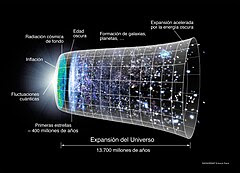
  • The universe began with a Big Bang, after which there was a phase of accelerated expansion (inflation), which then declined to levels close to the current ones. Ordinary matter appeared later, formed essentially by hydrogen and helium.
  • The average curvature of the cosmos is close to zero (flat universe): three-dimensional space is approximately Euclidean.
  • The average density of matter in the cosmos is equivalent to about 30% of the critical density (which separates an open, unlimited expanding cosmos from a closed cosmos that would contract again). Since the ordinary density of matter detected so far represents less than 5% of critical density, the remainder (over 25%) must be an unknown form (dark matter). In fact, it would be what is called cold dark matter, which explains the initials CDM in the name of the model. I talked about dark matter in an earlier post.