Thursday, September 26, 2019

The limits of quantum computing

Alan Turing
In an interview in a major Spanish newspaper (La Vanguardia) published on July 27, 2019, David Pérez García, a researcher in quantum physics, says this: We are just in the beginning of some technologies that we still don’t know how far they will go. He is right, because the future is hardly predictable, but when it comes to quantum computing we tend to think that these computers, if they are viable, will let us solve problems quite different from those that can be addressed by the traditional computers to which we are used. In this context, however, mathematics can help us distinguish between what can be done, and what is completely impossible.
Although quantum computing is a fairly modern concept, its theoretical foundation was established by Alan Turing during the 1930s. Let us review a little of what he showed, for in this way we can correct a few optimistic ideas spread by the media, often driven by experts who approach the issue from very different points of view, compared to Turing.

Thursday, September 19, 2019

The optimism of Teilhard de Chardin

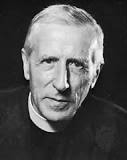
Pierre Teilhard de Chardin
Teilhard de Chardin’s vision of the future is essentially optimistic, perhaps too much. In his book The Phenomenon of Man he outlines his vision of the future evolution of human beings, which he presents as a process of increasing convergence towards a unifying center with the appropriate name of Omega Point.
By studying the unifying process that should take us to the next stage (or the final point) of our evolution, Teilhard distinguishes three different areas:

Thursday, September 12, 2019

Anniversaries of space exploration

Armstrong, Collins & Aldrin - Photo NASA
Fifty years after the arrival of man on the Moon, a couple of European sexagenarians remember the first landing:
“Do you know what day is today?”
“Saturday, why?”
“I mean the date.”
“July 20th 2019, what about it?”
“Exactly fifty years ago, man reached the Moon.”
“Oh yeah! But wait, there is something wrong here, didn’t they arrive on the twenty-first?”
"No, it was the twentieth, but it took them over six hours to get down from the capsule. By then, in Europe it was the twenty-first, but in the United States it was still the twentieth.”
“True! I remember it well. I saw it on TV. I was ten years old.”
“Me too.”

Thursday, September 5, 2019

George Ellis and the multiverse

George Ellis
George Ellis is a South African cosmologist who rose to fame almost half a century ago when he wrote a book together with Stephen Hawking (The Large Scale Structure of Space-Time, 1973), today considered a classic.
In an earlier post in this blog, published in November 2014, I mentioned that there are six independent theories about the multiverse, almost all of them incompatible with each other. In a recent article titled Theory Confirmation and Multiverses published in the book Why Trust a Theory?, edited by Radin Dardashti, Richard David and Karim Thébault (Cambridge University Press, 2019), George Ellis updates the different multiverse theories. He does not mention six, as I did five years ago, but nine, although he has left out one of the six I mentioned in my post (Smolin’s), perhaps because this theory has been abandoned in the meantime. The nine theories are:

Thursday, August 29, 2019

What are scientists researching about?

Plant research in space (NASA)
In previous posts I have mentioned some dangers faced by the future of science in the face of the growing obstacles suffered by basic research and the tendency of politicians to prioritize practical applications. The arguments I offered in those posts were qualitative. It is possible, however, to obtain real quantitative data, extracted from the journal Science News, which publishes a fairly complete summary of the results of research in all fields of science and technology. By analyzing 23,946 articles published during 30 years, I have obtained the following table, which shows the number of scientific news related to fourteen of the most researched topics in the fields of biology and medicine during that period of time. (More than half the research results belong to those two fields).

Thursday, August 22, 2019

Daring to say “I don’t know”

I don’t know. It seems quite simple. Why so few people dare to say it?
Several years ago, when it became fashionable in popular newspapers to publish mini-surveys, answered by four or five people, about a current issue, I wondered at seeing that, whatever the question, not one of them ever answered I don’t know. Everyone was perfectly clear about what they should answer in every case.
Some of the questions had substance:
  • How would you end the civil war in Yugoslavia?
  • How would you solve the unemployment problem?
  • How would you stop terrorism?

Thursday, August 15, 2019

Five years in PopulScience

Albert Einstein
This week we celebrate a small anniversary: five years since this blog was created. In this time, 245 posts have been published. The Spanish version of the blog is a little older: it was created 30 weeks before, in January 2014, and has published 257 posts.
To mark the date by some kind of celebration, I have decided to compute the list of people most mentioned in the blog in these five years. The following table shows the names of the ten people most quoted and the number of times their name has been quoted:
Name
Times quoted in PopulScience
Albert Einstein
42
Isaac Newton
33
Stephen Hawking
20
C.S. Lewis
20
Aristotle
17
Charles Darwin
14
Isaac Asimov
14
Richard Dawkins
12
Plato
10
Ptolemy
9