Showing posts with label Poul Anderson. Show all posts

Thursday, February 5, 2026

Time Travel and Christ’s Crucifixion

Christ crucified, wood carving
by Manuel Alfonseca Santana

If time travel were possible, the greatest incentive for travelers would be to witness firsthand famous events of the past, such as the assassination of Julius Caesar and many others. The fact that we have no record of the presence of strangers in any of these cases is a significant argument against the feasibility of time travel.

There is no doubt that one of these events, perhaps the most famous of all, would be the Crucifixion of Christ. If time travel were possible, there should have been an avalanche of visitors from future times at Golgotha ​​to witness the most important event in the history of humankind.

In fact, this idea has been used in science fiction literature. In a novella titled There Will Be Time, Poul Anderson has his protagonist travel to Jerusalem on the day of the Crucifixion to witness Christ's death. Upon arriving, he discovers a large crowd, almost all of whom are time travelers.

Thursday, November 6, 2025

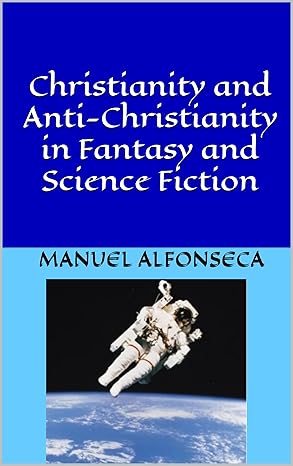
Christianity and Anti-Christianity in Fantasy and Science Fiction

A new book of mine has just been released with the same title as this post. It was published in Spanish by CEU Ediciones, and in English by Amazon.

There is a fairly widespread idea that we shouldn’t speak about Christian literature as a literary genre, except perhaps in fantasy, where the Christian character of such famous literary works as J.R.R. Tolkien's The Lord of the Rings or C.S. Lewis's The Chronicles of Narnia cannot be denied. In science fiction, the matter is not so clear. However, no one doubts that atheist literature does exist.

My book starts from the premise that an evident Christian literature exists in both genres, and demonstrates this by analyzing a series of authors and literary works, without neglecting anti-Christian literature, to which almost a third of the work is dedicated.

My predilection for fantasy and science fiction has been clear in this blog, given that over almost 12 years I've dedicated 34 posts to those two genres in literature and film; in other words, more than 6% of the posts.

Thursday, March 17, 2022

Traveling at the speed of light

Image of
"2001, a Space Odyssey"

Actually, the title of this post is wrong. Traveling at the speed of light is impossible, because it would take infinite energy to accelerate to that speed a body with rest mass greater than zero. What I am going to talk about here is travel at relativistic speeds (close to the speed of light), which means more than 10% of the speed of light (i.e. 30,000 kilometer per second).

Thursday, December 26, 2019

The 25 science fiction stories I most liked

Isaac Asimov

In the United States fiction is classified depending on the length of the work, with four subsequent stages:
  1. Novel, any work that has more than 40,000 words.
  2. Novella, a work between 17,500 and 40,000 words.
  3. Novelette, between 7,500 and 17,500 words.
  4. Short Story, less than 7,500 words.
Naturally, the limits are not strict, and in practice they depend on who classifies each book. In Spanish, however, we have fewer categories:
  1. Novel.
  2. Short novel, which applies to works of intermediate length.
  3. Story, with few characters and a simple plot.

Thursday, November 29, 2018

What would be an undeniable miracle?


In 1972, sci-fi writer and publisher Lester del Rey launched a challenge to three well-known authors of the genre: Poul Anderson, Robert Silverberg and Gordon R. Dickson. All three should write a novella on a specific topic: the effect of an undeniable miracle (the sun standing still) on human society. The three authors responded to the challenge, and the three stories were published jointly in a book entitled The day the sun stood still. In this post we shall consider the first of the three, written by Poul Anderson, whose title is A chapter of Revelation.
In a post in his blog, Pablo (a.k.a. sinopinionespropias) specifies which, in his opinion, should be the characteristics of an undeniable miracle:
1.      It must be a prophecy.
2.      Its materialization should not depend on people.
3.      Your probability must be negligible and calculable.
4.      It must be as concrete as possible.
5.      It must maintain the same demonstrative force with the passage of time.
6.      It must make sense at all times.

Thursday, July 12, 2018

Extraterrestrials in literature

Extraterrestrials can only appear in two types of literary works: in essays, or in novels, and in the latter only in the genre of science fiction. If an extraterrestrial appears in any novel, the novel automatically becomes science fiction.
Science fiction literature shows very many types of extraterrestrials:
  • Fully humanoid, such as the red men in the Mars series by Edgar Rice Burroughs, who are so humanoid that they are even fertile when mating with terrestrials, as shown by the two sons of John Carter and Dejah Thoris, despite the fact that Martian women are oviparous (!!!) To this group also belong the aliens of The People series by Zenna Henderson, who are only different from us by their mental abilities, and those of Perelandra by C.S.Lewis, also titled Voyage to Venus.
  • Partially humanoid, such as those in Star Ways by Poul Anderson, whose women are also capable of falling in love with terrestrials. This novel develops a typical Anderson argument: extraterrestrials who differ culturally from us in their ecological view of the world, but who are fated to be defeated when confronting terrestrials, who are much more active and aggressive than they are.