Showing posts with label fantasy novel. Show all posts

Thursday, November 6, 2025

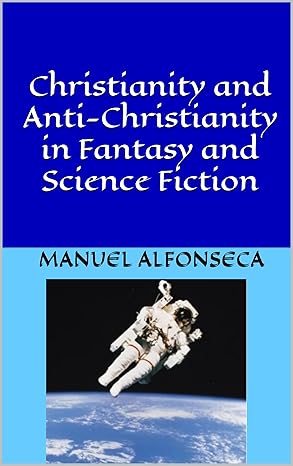
Christianity and Anti-Christianity in Fantasy and Science Fiction

A new book of mine has just been released with the same title as this post. It was published in Spanish by CEU Ediciones, and in English by Amazon.

There is a fairly widespread idea that we shouldn’t speak about Christian literature as a literary genre, except perhaps in fantasy, where the Christian character of such famous literary works as J.R.R. Tolkien's The Lord of the Rings or C.S. Lewis's The Chronicles of Narnia cannot be denied. In science fiction, the matter is not so clear. However, no one doubts that atheist literature does exist.

My book starts from the premise that an evident Christian literature exists in both genres, and demonstrates this by analyzing a series of authors and literary works, without neglecting anti-Christian literature, to which almost a third of the work is dedicated.

My predilection for fantasy and science fiction has been clear in this blog, given that over almost 12 years I've dedicated 34 posts to those two genres in literature and film; in other words, more than 6% of the posts.

Thursday, October 9, 2014

The curse of Chalion

The Curse of Chalion: a fantasy novel based on Spanish history

Book cover
The Curse of Chalion, by Lois McMaster Bujold, is one of the best fantasy novels of the latest years. It belongs to that rare category, which also contains Tolkien's Lord of the Rings, C.S.Lewis's Perelandra, Walter M. Miller Jr.'s Canticle for Leibowitz, or Poul Anderson's Orbit unlimited, that combine an interesting adventure plot with important ethical dilemmas and deep questions about the nature of man and God.
In this novel, as deftly crafted as her Vorkosigan saga, Lois McMaster Bujold has pushed further the bounds of subcreation as defined by Tolkien in his paper On fairie stories. She presents us, not just a coherent imaginary universe, but even a strange God, which rather than three persons displays five, together with important differences from the God we have heard about.