Showing posts with label statistics. Show all posts

Thursday, February 13, 2025

Anything can be assigned a probability?

In the previous post I mentioned the book Radical Uncertainty: Decision Making Beyond the Numbers by Mervyn King and John Kay. The book, written by two prestigious British economists, attacks the bad use of statistics and probability calculus in fields where they are not always applicable, such as history, economics and the law. Let’s look at a few examples:

  • What do we mean when we say that Liverpool F.C. has a 90% chance of winning the next match? One possible interpretation is that if the match were to be played a hundred times, with the same players and the same weather conditions and the same referee, Liverpool would win 90 times, and draw or lose the other ten. But the match will be played just once. Does it make sense to talk about probabilities? No, because there are no supporting data on frequency. What is meant is that the person speaking believes that Liverpool will win. Nothing more. It is a subjective probability. Milton Friedman wrote: We can treat people as if they assigned numerical probabilities to every conceivable event. (Price Theory, 1962).

Wednesday, January 10, 2024

Ten years of Divulciencia-Populscience

Next Monday marks ten years since the creation of my blog Populscience (called Divulciencia in its Spanish version). In this time, I have published 438 articles in both languages, plus another fifteen only in Spanish and eleven only in English.

You may remember that in the post I published one year ago to celebrate the nine years of existence of the blog, I included a figure that seemed to indicate that, after reaching a maximum of about 6,000 visits per month in October 2018, this number slowly decreased until reaching about 3000 visits (one half) in January 2023.

One year later, the figure is this:

Thursday, January 12, 2023

Nine years of Divulciencia-Populscience

Nine years after the creation of the blog Divulciencia (whose English version is named Populscience), I have published more than 400 posts, which is equivalent to about 45 posts a year (in summer I take vacations and do not publish).

These posts are classified into 25 thematic threads, of which the most visited is What is man?, one of whose posts, Is man just an animal? is the most visited post in the blog, with more than 55,000 visits.

Thursday, July 11, 2019

Zero probability


In a previous post I mentioned that an event can happen once or several times, although the probability of its happening is zero. The probability of an event is defined as the ratio of the number of favorable cases to that of possible cases. Therefore, if the number of possible cases is infinite, while that of favorable cases is finite, the probability turns out to be zero.
At first glance it seems incredible that an event with zero probability can actually happen. I think the matter will be clearer with a simple example. Two friends, A and B, are talking, and what they say is this:
A: If I ask you to choose a number between 1 and 100, what is the probability that you choose a specific number, such as 25?
B: 1/100, obviously.
A: If I ask you to choose a number between 1 and 1000, what is the probability that you choose 25?
B: 1/1000.
A: If I ask you to choose a number between 1 and 10,000, what is the probability that you choose 25?
B: 1/10,000.
A: If I ask you to choose a positive integer number, what is the probability that you choose 25?
B: Zero, for the set of integers has infinite elements, and one divided by infinity is equal to zero.
A: Choose any number among all the positive integers and tell me which number you have chosen.
B: I choose 22500-1.
A: You have just made an event with zero  probability.
Thinking a little you’ll see that the probability of choosing, among all the integers, any finite set, however large, is also zero. For instance:
A: If I ask you to choose ten different numbers between one and one hundred, what is the probability that you choose precisely the numbers between 11 and 20? (their order does not matter)
B: 1 / 17,310,309,456,440
A: And if I ask you to choose ten different numbers among all the positive integers, what is the probability that you choose precisely the numbers between 11 and 20?
B: Zero.
I leave to the curious reader to compute why the probability of choosing numbers 11 to 20 among those from one to one hundred is precisely what B has stated.
To finish this post, I’ll propose a few more exercises for the reader. Whoever solves them has the opportunity to write a comment explaining how they arrived to the solution.
1.      What is the last digit of 62500?
2.      What is the penultimate digit of 62500?
3.      What is the penultimate digit of 61,000,000?
4.      What is the probability that the last digit of 6n is odd?
5.      What is the probability that the penultimate digit of 6n is odd?
By Vincent Pantaloni, CC BY-SA 4.0, Wikimedia Commons

The same post in Spanish
Thematic Thread on Statistics: Previous Next
Manuel Alfonseca
Happy summer holidays. See you by mid-August

Thursday, August 27, 2015

Surveys and statistics: opinions and facts

Henry Whitehead (1825-1896)
We tend to confuse the majority opinion with the truth. This is wrong, as expressed by Henry Whitehead:
Never fear forming a minority of one; majorities are usually wrong.
But sometimes the consequences drawn from public opinion are even more misleading than the opinion itself. In an article entitled Are we xenophobic? published in a Spanish high-diffusion newspaper on March 17, 2011, the author discussed the result of an official survey:
...Citizens believe that immigrants receive from the state...
lots more (30.8%) or just more (38.7%) than they contribute.
And he drew from this result the following comment:
Any sociological diagnosis would understand these figures
as a breeding ground for a reactionary and xenophobic social culture.
Saying the opposite is tantamount to denying a consistent reality.

Thursday, February 5, 2015

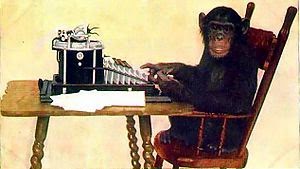
The monkey pounding on a typewriter

In connection with the fine tuning problem, the argument of the typist monkey is often used as an illustration that even very unlikely events can occur spontaneously. Depending on the author of the quote, the text supposedly written by the monkey can be the complete works of Shakespeare, Don Quixote, or even a shorter and less specific work. For instance, John Leslie, in his book Universes (Chapter One), writes:
Our universe can indeed look as if designed. In reality, though,  it may be merely the sort of thing to be expected sooner or later. Given sufficient many years with a typewriter, even a monkey would produce a sonnet.

Thursday, October 30, 2014

On-line bullying

In an article by the press agency Europa Press published on June 28 2012, which refers to a study performed by Microsoft among youths in the age range 8 to 17, it is stated that 37% of Spanish youths suffer on-line bullying through the Internet. This looks like a high figure, but it may depend on how bullying is defined.
Reading the article, it appears that 17 per cent of the polled declares having been addressed in an unfriendly way, 13 per cent have been targets of mockery and 19 per cent have felt insulted. Also, 24% of the youth confess that they bully other people.
Neither in the Europa Press article, nor in the summary of the Microsoft study, is there a definition of unfriendly behavior and the other forms of bullying. It appears that the youths who answered the poll just considered it thus.