Showing posts with label dark energy. Show all posts

Thursday, July 3, 2025

Mysterious Particles

Some physicists sometimes act as if the hypotheses they propose to explain the mysteries of the universe are always true. But a hypothesis is nothing more than a proposal to explain a natural phenomenon, and it cannot be considered a confirmed theory until it has provided one or more surprisingly accurate predictions. This last detail, which is essential, is usually omitted.

In 2020, I read two popular books on cosmology and particle physics (the two branches of physics are closely related):

Thursday, May 15, 2025

Phantoms in the Universe?

The Standard Cosmological Model has introduced in physics two new concepts that didn't exist before:

  • Dark matter: It seems to be five times more abundant than ordinary matter, but we don't know what it is, what it's made of. We only know that it appears to be affected by gravity, and so far, its existence has been concluded in two different ways: a) By analyzing the rotational motion of galaxies, which seems to require that there is more mass in them than what we can see. b) By studying the cosmic microwave background radiation, which has served as the basis for adjusting the standard cosmological model.
  • Dark energy: We have no idea what it is. Some speak of a fifth fundamental interaction (or force), the quintessence, which would join the four we know: gravitational, electromagnetic, strong, and weak. Others offer different explanations, none of which have received experimental confirmation. The hypothesis of its existence is supported by two observations: a) Analyzing the expansion rate of the universe, after the 1998 discovery that this rate is accelerating. b) By studying the cosmic microwave background radiation, which has served as the basis for adjusting the standard cosmological model.

Thursday, June 20, 2024

The dream of antigravity

Man has always wished to be able to fly. Seeing how birds do it and not being able to do it has obsessed him, to the point of causing quite a few accidents. It is a craving that even very young children know. Some mishaps caused by the viewing of the movie Superman at the end of the seventies may be proof.

At the end of the 19th century, two fundamental interactions were known: electromagnetic and gravitational. In one respect, both are quite different. Electrically charged bodies can have a positive or a negative charge. A positive and a negative charge attract each other; two positive or two negative charges repel each other. Likewise, magnetic bodies have two ends with magnetism of a different type, north and south. If we bring two magnets together, the north end of one and the south end of the other attract each other; ends of the same type repel each other.

Thursday, March 28, 2024

The mystery of the cosmological constant

Alexander Friedmann
(Александр Фридман)

This post completes a previous post with a similar title:

The problem of the cosmological constant.

First of all, we should define three different concepts that could be closely related:

  1. Vacuum energy: due to the constant appearance of pairs of particles and antiparticles that immediately mutually disintegrate, so they are undetectable through direct experimentation. Their appearance is a consequence of the uncertainty principle: ΔΔt<ħ/2, which implies that a particle with energy ΔE can appear spontaneously during a time Δt<ħ/(2ΔE), which is smaller for larger ΔE. Thus, a virtual electron would last less than 4×10-21 seconds. A proton, whose mass is 1837 times greater, would last 1837 times less. By applying quantum field theory to all the known particles, the energy of the vacuum can be estimated.
  2. The cosmological constant: introduced by Einstein in his cosmological equation, which in the format devised by Alexander Friedman is expressed as follows: The symbol Λ is the cosmological constant. Einstein proposed a negative value, to compensate for a cosmic expansion, in which he initially did not believe. Today it is thought to be positive, which would explain the accelerated expansion of the universe discovered in 1998.
  1. Dark energy: an unknown agent that would cause the accelerated expansion of the universe.

Wednesday, November 24, 2021

The top ten scientific discoveries of the century

The magazine Science News has reached in 2021 one hundred years (a century) of existence. To celebrate this anniversary, the magazine has published a list of what, according to its author, are the ten greatest scientific advances made between 1921 and 2021. This is the list, ordered according to the opinion of the article’s author about the importance of the discovery (from highest to lowest):

Thursday, March 5, 2020

Is there energy in the cosmos?

Georges Lemaître
During the 1950s two cosmological theories entered in competition: the Big Bang, proposed by Georges Lemaître, and the steady state, proposed by Hermann Bondi and Thomas Gold. Although the second had to renounce the principle of the conservation of energy, the most sacred of physics, atheist cosmologists preferred it to the Big Bang, as it seemed to them that this theory required to accept God's creation. In the words of the English astronomer Raymond Littleton, in his popularization book The Modern Universe (1956):
A theory such as this [the Big Bang] that puts back creation to a singular instant in the remote past... to some minds it is an objection that it would imply the removal of the question of the origin of the material of the universe from the realm of science... This consideration does not of course mean that the explosion theory is necessarily wrong, but it puts the act of creation, as we might name it, beyond the reach of science.
In other words: Raymond Littleton objects to the Big Bang theory because it could force us to recognize the existence of a creative God. It cannot be said more clearly.

Thursday, July 5, 2018

Is Physics science or literature?


Freeman Dyson, who proposed a way
to extract energy from stars
We usually assume that physics is the most rigorous of the experimental sciences, the closest to mathematics, which serve as the fundamental basis for all sciences. However, some recent developments raise doubts about this. In other articles I have spoken of a few: the theories of the multiverse, time travel, that usually provide appealing headers in the media, but cannot be considered scientific theories, not because they cannot be verified, but because they cannot be proved false.
A recent article published in the high-profile journal Science News can be classified within this group, and in my opinion adds fuel to the fire, endangering the prestige of physics as a rigorous science and turning it into science fiction literature. This publication refers to an article recently published in arXiv, whose title is quite indicative: Life versus Dark Energy: How an Advanced Civilization Could Resist the Accelerating Expansion of the Universe. This article has been classified in the category Cosmology and Nongalactic Astrophysics.

Thursday, May 10, 2018

What’s a scientific theory

Karl Popper
Although it is fashionable to assert that Karl Popper’s theories about the evolution of science are outdated, his definition of what is a scientific theory is unassailable:
A theory is scientific if and only if it is possible to design an experiment that proves that this theory is false.
A paradigmatic case is the Copenhagen Interpretation of Quantum Mechanics. In 1935, Einstein, Podolsky and Rosen designed an experiment that could prove this theory false. A few months later, Niels Bohr published another article in the same magazine, in answer to the previous article. Almost 30 years later, as I explained in another post in this blog, the EPR experiment, which up to that point had been mental, could be carried out and confirmed Bohr’s predictions, rather than Einstein’s. As this theory was able to resist an attempt to prove it false, it must be considered a scientific theory.
Of course, this success of the theory does not imply that it should automatically be considered correct or true. Scientific theories (always according to Popper) never become so. This theory has successfully withstood an attempt to prove it false, but the next attempt could do it.

Thursday, May 3, 2018

The standard cosmological model

Map of the Cosmic Background Radiation
In 1927, the Belgian priest and astronomer Georges Lemaître discovered Hubble’s law.
Yeah that’s right. Hubble did not discover the law until 1929. What happened was that Lemaître published it in French in a low-impact journal (Annales de la Société Scientifique de Bruxelles), while Hubble published it two years later in English in the Proceedings of The National Academy of Sciences, received much more publicity and his name got associated with the discovery.
Combined with Einstein’s cosmological equation, Lemaître-Hubble’s law implies that the universe is expanding. In an article published in 1931 in Nature, Lemaître drew the consequence by proposing the Big Bang theory, so called in derision by its opponent Fred Hoyle in 1950. The name caught on.
In 1948, Ralph Alpher, George Gamow and Robert Herman made two surprising predictions, based on the Big Bang theory: the average composition of the mass of the cosmos (three quarters hydrogen and one quarter helium), and the existence of the cosmic background radiation. Both were confirmed during the sixties. From that point, the Big Bang theory became the standard cosmological theory.

Thursday, March 15, 2018

Dark energy again

Albert Einstein
In a previous article I mentioned that Einstein introduced a third term in the right side of his cosmological equation, to force this equation to have as solution a stationary cosmos, that would not expand or contract. The attempt was unsuccessful, for such a cosmos would have been in unstable equilibrium, and the smallest variation would have pushed it to either expanding or contracting. The term in question depends on a constant (L, the cosmological constant), which we don’t really know what it is.
Einstein's cosmological equation
For most of the twentieth century, it was assumed that the value of the cosmological constant must be zero. In other words, the third term of the Einstein equation would not exist, wouldn’t be necessary. However, in 1998 it was discovered that the universe seems to be expanding rapidly. At least, this seems to be indicated by the study of supernovas in very distant galaxies, about one billion light-years away from us. To explain this discovery, the cosmological constant term was resurrected, but giving it a sign opposite to that proposed by Einstein, so that rather than the expansion being counteracted, it would be accelerated. This proposal has become the standard cosmological model, in which the first term of the equation, which represents the effect of the mass, currently counts as 31%, while the third, that of the cosmological constant, counts as 69%. In this model, the second is assumed to be zero. I leave apart the question that the mass term does not match, so it has been necessary to assume that there is also a dark matter, that we don’t know what it is.

Thursday, February 16, 2017

Pending problems in the standard cosmological model

The standard cosmological model, prevailing since 1998, is called LCDM and is based on the following statements:
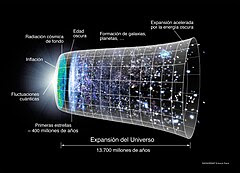
  • The universe began with a Big Bang, after which there was a phase of accelerated expansion (inflation), which then declined to levels close to the current ones. Ordinary matter appeared later, formed essentially by hydrogen and helium.
  • The average curvature of the cosmos is close to zero (flat universe): three-dimensional space is approximately Euclidean.
  • The average density of matter in the cosmos is equivalent to about 30% of the critical density (which separates an open, unlimited expanding cosmos from a closed cosmos that would contract again). Since the ordinary density of matter detected so far represents less than 5% of critical density, the remainder (over 25%) must be an unknown form (dark matter). In fact, it would be what is called cold dark matter, which explains the initials CDM in the name of the model. I talked about dark matter in an earlier post.

Thursday, November 12, 2015

Einstein’s mistake

When Einstein formulated in 1915 his theory of general relativity, he soon applied it to the entire universe, deriving the following cosmological equation:


It is curious that this equation is identical to the equation that would result from Newton’s theory of gravitation. There is only one difference: constant k represents, in Newton’s case, the total energy of the universe; in Einstein’s case, its curvature.
Each term of this equation contains a universal constant. Besides k, G is the gravitational constant; L is called the cosmological constant, whose interpretation is not clear. Einstein initially thought he could eliminate this term by making L = 0, which simplifies the equation and makes it analytically solvable. Then he discovered that the solution, in that case, was a universe in constant expansion. Since he believed that the universe had to be stationary, he decided to assign the constant a critical value L = Lc, to make it be so.