Showing posts with label Alexander Friedmann. Show all posts

Thursday, May 15, 2025

Phantoms in the Universe?

The Standard Cosmological Model has introduced in physics two new concepts that didn't exist before:

  • Dark matter: It seems to be five times more abundant than ordinary matter, but we don't know what it is, what it's made of. We only know that it appears to be affected by gravity, and so far, its existence has been concluded in two different ways: a) By analyzing the rotational motion of galaxies, which seems to require that there is more mass in them than what we can see. b) By studying the cosmic microwave background radiation, which has served as the basis for adjusting the standard cosmological model.
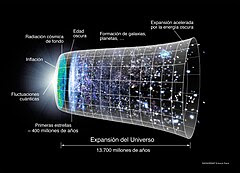
  • Dark energy: We have no idea what it is. Some speak of a fifth fundamental interaction (or force), the quintessence, which would join the four we know: gravitational, electromagnetic, strong, and weak. Others offer different explanations, none of which have received experimental confirmation. The hypothesis of its existence is supported by two observations: a) Analyzing the expansion rate of the universe, after the 1998 discovery that this rate is accelerating. b) By studying the cosmic microwave background radiation, which has served as the basis for adjusting the standard cosmological model.

Thursday, March 28, 2024

The mystery of the cosmological constant

Alexander Friedmann
(Александр Фридман)

This post completes a previous post with a similar title:

The problem of the cosmological constant.

First of all, we should define three different concepts that could be closely related:

  1. Vacuum energy: due to the constant appearance of pairs of particles and antiparticles that immediately mutually disintegrate, so they are undetectable through direct experimentation. Their appearance is a consequence of the uncertainty principle: ΔΔt<ħ/2, which implies that a particle with energy ΔE can appear spontaneously during a time Δt<ħ/(2ΔE), which is smaller for larger ΔE. Thus, a virtual electron would last less than 4×10-21 seconds. A proton, whose mass is 1837 times greater, would last 1837 times less. By applying quantum field theory to all the known particles, the energy of the vacuum can be estimated.
  2. The cosmological constant: introduced by Einstein in his cosmological equation, which in the format devised by Alexander Friedman is expressed as follows: The symbol Λ is the cosmological constant. Einstein proposed a negative value, to compensate for a cosmic expansion, in which he initially did not believe. Today it is thought to be positive, which would explain the accelerated expansion of the universe discovered in 1998.
  1. Dark energy: an unknown agent that would cause the accelerated expansion of the universe.