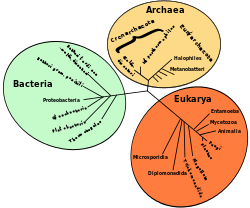
In the previous post, I discussed cladistics, the new way of classifying living things based on their position in the tree of life, and mentioned some of the difficulties that arise when trying to adapt the previous classification system, based on the taxonomic tree and Linnaeus's classic categories—kingdom, phylum, class, order, family, genus, and species—to cladistics.
There are more difficulties. For example, let's consider the concept of kingdom, Linnaeus's highest taxonomic category. Traditionally, living things were divided into two kingdoms: animals and plants. These two kingdoms were clearly separate, with very different characteristics. Thus, animals were defined as organic beings that live, feel, and move by their own impulse, while the plant kingdom were beings that live but do not feel and do not move. It was acknowledged that these definitions were imperfect, because there were exceptions, such as sponges, which barely move but are animals, and some plants, like mimosas, which seem to sense certain stimuli and move in response.
The first serious problem arose with the discovery
of microorganisms. Initially, attempts were made to fit them into the previous
system, dividing them into unicellular animals (Protozoa) and unicellular plants (Protophyta). But in the microscopic world, the separation
between animals and plants becomes blurred, so in the mid-20th century, a third
kingdom was added to the two previous ones: the protists, which encompassed all unicellular organisms, from
which plants and animals would have evolved.
Shortly afterward, biologists concluded that the
plant kingdom should be divided into two: on the one hand, fungi (heterotrophic
organisms lacking chlorophyll, leaves, and roots, which reproduce by spores and
live parasitically, in symbiosis, or on decaying organic matter). On the other hand, all other plants, the Metaphyta (autotrophic
and photosynthetic organisms whose cells have walls composed primarily of
cellulose, and which lack the ability to move).

Around 1980, the protist kingdom was divided into three: bacteria, archaea, and unicellular eukaryotes. We thus had a total of six kingdoms, which were further grouped into two categories above the kingdoms, called empires or domains. The classification was as follows:
·
Empire of prokaryotes, cells without a nucleus.
o Kingdom of
Bacteria
o Kingdom of
Archaea
·
Empire of eukaryotes, cells with a nucleus.
o Kingdom of
eukaryotic protista
o Kingdom of
Plants or Metaphyta
o Kingdom of
Fungi
o Kingdom of Animals or Metazoa
It seemed that the
matter was settled. But with the arrival of cladistics, which insists that every biological group
must be linked to all its descendants, things got complicated.
 ·
On
the one hand, eukaryotes descend from prokaryotes, so their kingdom should be
included within them.
·
On
the one hand, eukaryotes descend from prokaryotes, so their kingdom should be
included within them.
·
On
the other hand, eukaryotes descended through symbiosis from bacteria and
archaea (a bacterium was engulfed by an archaeon, and instead of being digested,
it was incorporated and transformed into a mitochondrion). How does that fit
into the cladistic classification?
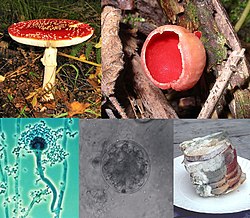
· Finally, fungi, and probably plants as well, would have to be divided into several kingdoms because they are polyphyletic, meaning that they do not descend from a single ancestor, but from several earlier groups on the tree of life, and therefore do not constitute a clade.
The conclusion is that, of the six kingdoms
recognized in biological classifications, only one (animals) would be a true
clade.
An additional problem is this: some biologists,
staunch proponents of cladistic classification, argue that if we decide to call
unicellular eukaryotes (for example) a kingdom, then all the prokaryotic
branches that diverged from the ancestors of eukaryotes before the emergence of
eukaryotes and gave rise to independent branches of the tree of life should
also be considered kingdoms. There would thus be more than 50 kingdoms of
living beings, almost all unicellular prokaryotes, some of them with few known
species. Such a classification would not be very useful. Therefore, for
practical purposes, strict cladistic rules are not usually applied at the
kingdom level.
Finally, some biologists believe that humans should
be considered a kingdom of nature, since our species has given rise to a new
type of evolution—cultural evolution—with rules similar to, but subtly different from,
those of biological evolution. I discussed this in one
of the older posts in this blog.
Thematic Thread on Evolution: Previous Next
Manuel Alfonseca

No comments:
Post a Comment