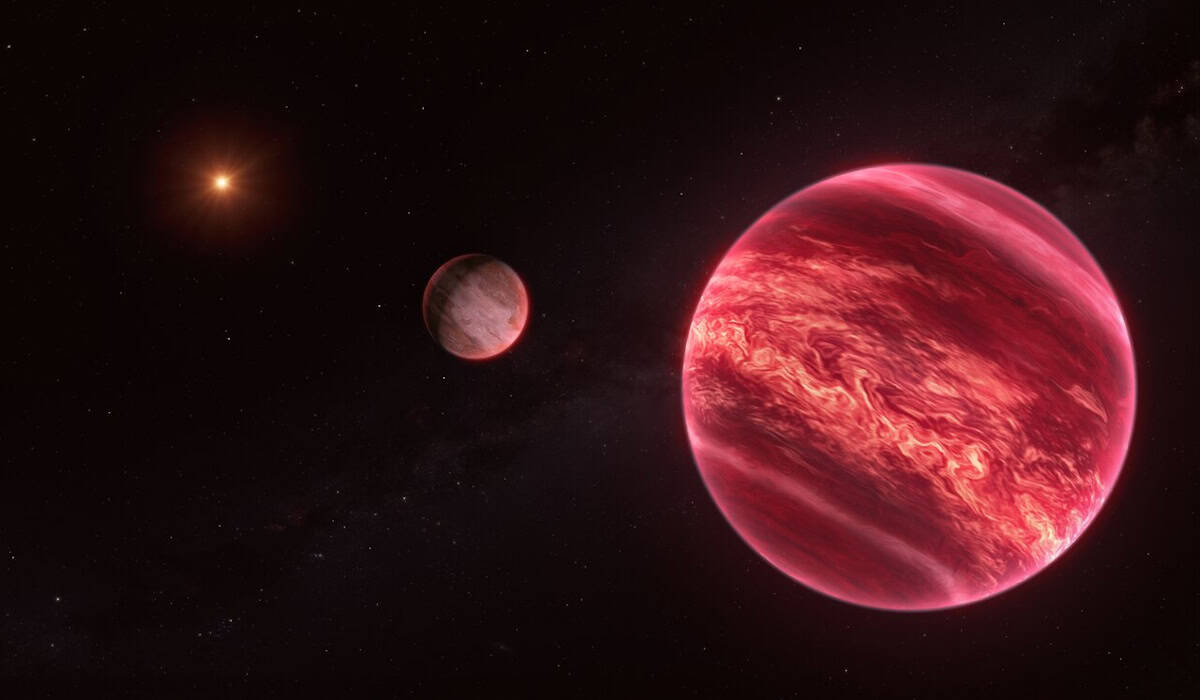
 |
| ESO/M Kornmesser |
On July 23, the journal Nature published an article announcing the discovery of what it called an “exosatellite,” although in my opinion, this is a wordplay with the meaning of the word satellite. Let's look at the concepts involved:
· In our solar system, there is a central star, the Sun, around which eight planets, several smaller planets, and many thousands of asteroids and comets revolve. In addition, almost all the planets have satellites, much smaller than the planets. The largest in proportion to its planet is the Moon, whose mass is 81 times less than that of Earth. There are four satellites larger than the Moon: three of Jupiter (Ganymede, Callisto, and Io) and one of Saturn (Titan). Many exoplanets have been discovered in systems of this type.
·
Other systems are binary or ternary, with two or three stars bound together by
gravity, each of which may have planets, and these could have satellites, although
no examples of the latter have been confirmed so far because, if they existed,
they would be very small. Alpha Centauri, the closest star to ours, is a triple
system, consisting of Alpha Centauri A (a twin of our Sun), Alpha Centauri B (a
little smaller), and Proxima Centauri (a red dwarf). Only the latter has been
confirmed to have three planets. The other two have unconfirmed candidates.
 |
| Red dwarf Proxima Centauri |
The system described in the Nature article is
somewhat unusual. It is a binary system consisting of a red dwarf star and an
even smaller brown dwarf, located about 73 light-years from us. A Jupiter-sized
body has been discovered orbiting the brown dwarf, and this is being considered
as a satellite.
The red dwarf is, without a doubt, a star. The
question under debate hinges on the definition of brown dwarfs. What are these
celestial bodies? Stars or planets?
A brown dwarf has a mass between 13 and 80 times
greater than the mass of Jupiter, insufficient for hydrogen fusion to occur
within its core, although the fusion of deuterium, tritium, or lithium can take
place. This is why they are often called failed stars. We have two
possibilities:
1. If it is
decided that the brown dwarf is not a star, it would have to be considered a planet of the
red dwarf. Then, the newly discovered object would be a satellite of this
planet. However, it would be a huge satellite, as it is the size of Jupiter.

2.
If we consider the brown dwarf to be a star, the newly discovered object would be a planet of
that star. We would have a binary system with a giant planet.
As the title of the Nature article indicates, its
authors have chosen the first option, I suspect influenced by the desire to be
the discoverers of the first confirmed exosatellite, but at the cost of
stretching the definition of a satellite. In my opinion, the second option is
more logical.
Thematic Thread on Space Exploration: Previous Next
New edition of this book: Biological and cultural evolution in the history of life and man
Manuel Alfonseca

No comments:
Post a Comment