Thursday, October 29, 2026

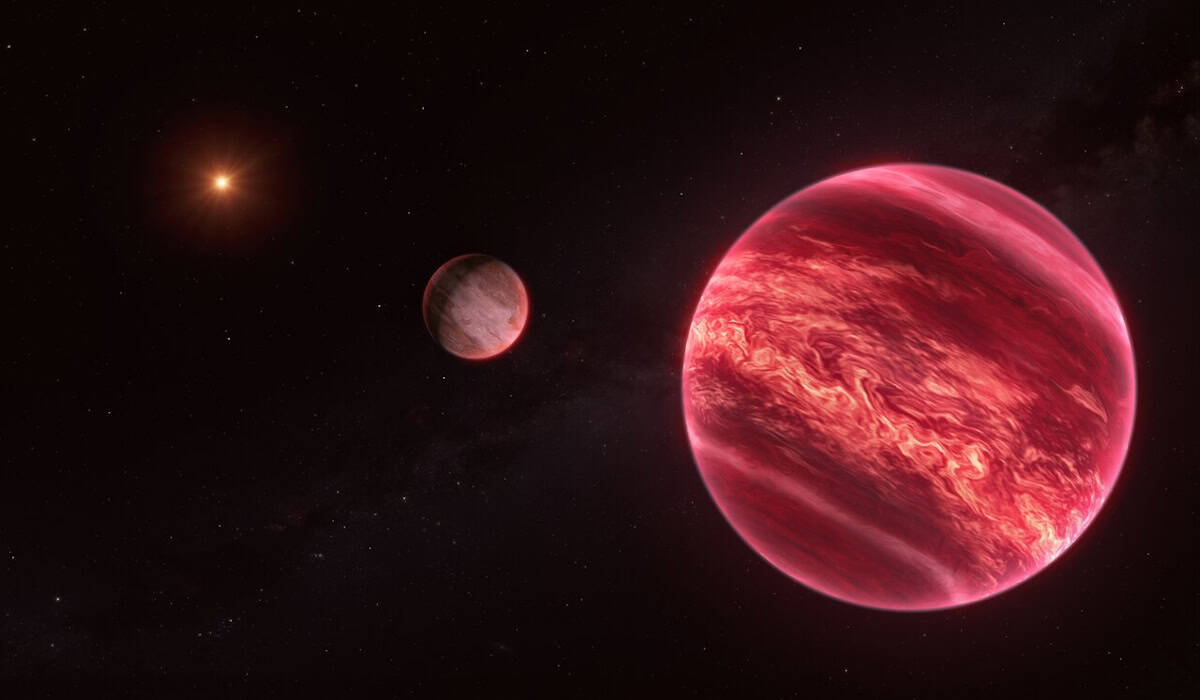
Second-generation planets

Betelgeuse, a red giant

Theories regarding planet formation have evolved over time. In the early decades of the 20th century, it was assumed that the planets of the solar system were formed when a passing star came close to the Sun and, through gravitational attraction, stripped away material that subsequently coalesced into planets. Given that such close encounters between stars must be extremely rare, this theory implied that the existence of planets around a star would be a highly uncommon phenomenon.

Current theory differs. It is now believed that when a cloud of gas and dust contracts to form a star, a portion of the cloud remains outside the protostar, forming a disk that flattens around the system's equator. Gradually, the gas and dust concentrate and condense around larger nuclei, eventually giving rise to planets. This theory explains why nearly all planets in the solar system orbit the Sun in roughly the same plane. It suggests that the existence of planets should be commonplace; indeed, the discovery of thousands of planets around nearby stars lends strong support to this theory.

Thursday, October 22, 2026

A city on the Moon?

Moonbus 2001
Lunar transport vehicle, film 2001

Building a lunar colony is a favorite theme in science fiction. I would cite one of my favorite stories featuring such a colony: The Menace from Earth by Robert A. Heinlein (1957). A lunar colony also appears in the novel and film 2001: A Space Odyssey by Arthur C. Clarke.

Recently, with the return of humans to the Moon (still in its early stages, as astronauts have only orbited the Moon), there has been renewed discussion about the possibility of building a permanent lunar facility. There is even talk of establishing a city, with a population of over 100,000.

A piece in Physics World—referencing another article published in Frontiers in Space Technologies—addresses this issue by examining the needs of a lunar colony and the potential cost of maintaining it.

Thursday, October 15, 2026

A planet, or a satellite?

ESO/M Kornmesser

On July 23, the journal Nature published an article announcing the discovery of what it called an “exosatellite,” although in my opinion, this is a wordplay with the meaning of the word satellite. Let's look at the concepts involved:

·         In our solar system, there is a central star, the Sun, around which eight planets, several smaller planets, and many thousands of asteroids and comets revolve. In addition, almost all the planets have satellites, much smaller than the planets. The largest in proportion to its planet is the Moon, whose mass is 81 times less than that of Earth. There are four satellites larger than the Moon: three of Jupiter (Ganymede, Callisto, and Io) and one of Saturn (Titan). Many exoplanets have been discovered in systems of this type.

Thursday, October 8, 2026

Ontological proof of God’s existence

Elizabeth Anscombe 

In 1078, Saint Anselm of Canterbury proposed a proof of God’s existence in his work Proslogion, which has given rise to various versions that attempted to improve it (usually without success) and to attempts to demolish it. Even today, it continues to provoke the attention of philosophers and corrections to its translation. This is Saint Anselm's argument, originally written in Latin, as it is usually translated:

i.      That than which nothing greater can be conceived at any rate exists in the mind of the fool who says there is no such thing.

ii.   If that than which nothing greater can be conceived is only in a mind, it can be thought to exist in reality too, which is greater.

iii. Therefore if that than which nothing greater can be conceived is only in a mind, it is not that than which nothing greater can be conceived.

iv.  But it is a contradiction to say that something than which nothing greater can be conceived is something than which a greater can be conceived.

v.    Therefore that than which nothing greater can be conceived exists in reality as well as in the mind.

Thursday, October 1, 2026

The Origin of the Universe and the Immortality of the Soul

Aristotle

The philosophical and scientific works of Aristotle were lost to Western Europe for centuries and were rediscovered through Arabic translations. Their rediscovery gave rise to a Western European philosophical movement, Scholasticism, with such prominent figures as Albertus Magnus, Thomas Aquinas, Duns Scotus, William of Ockham, Jean Buridan, Albert of Saxony, Nicholas Oresme, Gregory of Rimini, and many others.

I will recall here a curious debate that took place among the Scholastics between the 12th and 14th centuries, which may seem pointless to us today, but which was quite important in its time. For those who wish to learn all the details of the debate, I recommend Pierre Duhem's book, Le Système du Monde, volume VII.

The debate originated from the detection of an incompatibility between two statements due to Aristotle: