 |
| Henri Poincaré |
As a scientist, Henri Poincaré was a mathematician
who worked in many fields of that science, both theoretical and applied, the
latter mainly to physics. Among other things, he achieved a partial solution to
the three-body problem and is considered a precursor to chaos theory.
As a philosopher of science, Poincaré was one of
the main representatives of the philosophical theory called conventionalism or instrumentalism, which holds that scientific theories are conventional and do not
represent reality, but are useful if they can be used to make correct
predictions. As I explained in another
post, other scientists and philosophers of science, such as Karl Popper,
are realists
and believe that scientific theories do represent reality, and the more
accurately they represent it, the better their predictions will be. Personally,
I am not a conventionalist and feel closer to Popper than to Poincaré.
The book by Poincaré that I am going to discuss is titled La Science et l’Hypothèse and was first published in 1902. In this book, with which I obviously disagree, Poincaré defends his instrumentalist ideas.
In the first part of the book, he opposes the widespread idea that mathematics relies essentially on the deductive method. He argues that mathematical induction is much more important, and that this tool cannot be considered part of the deductive method. However, we must bear in mind that mathematical induction is not the same as the inductive method used in experimental sciences, although the similarity of names is sometimes misleading. Mathematical induction provides absolute certainty, which is not the case with the inductive method. In my opinion, and contrary to Poincaré's, mathematical induction is indeed part of the deductive method.
In the second part of the book, Space, he mixes geometry with anatomy and attempts to
explain our feeling of living in three-dimensional space, based on the muscular
movements of the eye to ensure that the image of a moving object maintains its
relative position relative to us. I find this explanation far-fetched. As far
as I know, I don't usually move my eyes so that moving objects keep their
relative position; I just see them move. And to see that space has three
dimensions, I just have to look at a corner of the ceiling of my room. Poincaré's
aim with this elucidation is to assert (he does so at the end of this part)
that geometry
isn't true, it's merely advantageous. Geometry would be a simple consequence of natural
selection and wouldn't give us a faithful image of the world, but only the most
advantageous for our survival. This conventionalist explanation seems to me
forced and elaborate.
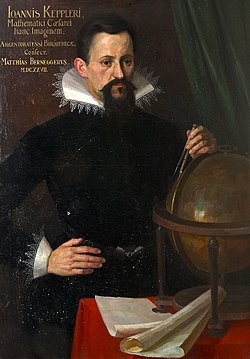 |
| Johannes Kepler |
The third part is outdated, as this book was
published before the theory of Relativity. Discussions about the difficulty in
defining the gravitational force, for example, are unnecessary, for in General
Relativity gravity is defined as a geometric deformation of space in the
presence of mass. But Poincaré’s distinction between accidental and universal
constants is interesting. Among the former, he cites the area constant in Kepler's
second law, whose
value could have been different, at least as far as we know. Among the
essential constants, he cites the exponent 2 of Newton's equation, which in a
three-dimensional space cannot take any other value.
The inklings about God's existence based on
fine-tuning—the observation that the values of the universal constants are
precisely those necessary to make life possible—are always based on accidental
constants, according to Poincaré's definition. If it were proved that all these
constants can only have the value they have, i.e. that instead of being
accidental, they are essential, they would lose their value as inklings. But we
are very far from proving this, since these constants are too many (around 40),
and we have no arguments to support that the only possible universe is
precisely our own.
 |
| Karl Popper |
The fourth part, dedicated to scientific
hypotheses, has been surpassed by the work of Karl Popper, Thomas Kuhn and
other authors, although it introduces a few interesting ideas, such as the
following quote, which graphically expresses the difference between history and
experimental science:
Carlyle has
said somewhere something like this: "Nothing but facts are of importance.
John Lackland passed by here... Here is a reality for which I would give all
the theories in the world." Carlyle was a fellow countryman of Bacon; but
Bacon would never have said that. That is the language of the historian. The
physicist would rather say: "John Lackland passed by here; that makes no
difference to me, for he never will pass this way again."
Or this quote, that expresses quite well the
difference between theoretical and experimental physics:
The librarian has at his disposal insufficient funds for his purchases. He ought to make an effort not to waste them. Experimental physics is entrusted with the purchases. It alone can enrich the library. As for mathematical physics, its task will be to make the catalogue. If the catalogue is well made, the library will not be any richer, but the reader will be helped to use its riches. And by showing the librarian the gaps in his collections, it will make possible a judicious use of the funds; which is quite important, because these funds are entirely inadequate.
Thematic Thread about Science in General: Previous Next
Manuel Alfonseca

No comments:
Post a Comment