.jpg/250px-Leo_XIV_(13_October_2025).jpg)
The publication of Pope Leo XIV's Encyclical Magnifica Humanitas has prompted some people to accuse it of being an exercise in Luddism and a return to the Middle Ages (many of these people know little about the medieval period), sometimes accompanied by gruesome images of robots being burned at the stake, undoubtedly generated using AI tools. The speed of their responses is so surprising that one may wonder if they are judging the text without having read it. Are they right? Can the encyclical be accused of Luddism?
Let's begin by defining the word Luddism, as it appears in the Merriam-Webster dictionary:
The beliefs
or practices of the Luddites: one of a group of early 19th century English
workmen destroying laborsaving machinery as a protest. Broadly : one
who is opposed to technological change.
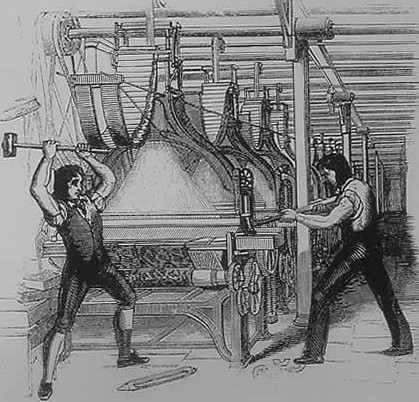
It is, therefore, a term primarily applied to the use of violence against technological advancements. Violence is certainly difficult to justify, although in Ned Lud's case it is understandable, considering what happened at the time as a consequence of the introduction of machinery (looms) in textile factories. Some employers took advantage of this to dismiss their workers, telling them something like this:
Send us
your children, for they will be able to operate these simple machines as well
as you.
Let's look at a few paragraphs from the encyclical
that some might mistake for Luddism:
95. When
such power is concentrated in the hands of a few, it tends to become opaque and
evade public oversight, increasing the risk of distorted forms of development
that give rise to new dependencies, exclusions, manipulations and inequalities.
As Juvenal said: Quis custodiet ipsos custodes? Who controls those who control us? That half-dozen multinational corporations that accumulate so much power and usually evade the control of users and governments.
104-105. For
this reason, ethical discernment cannot be limited to asking whether we are
using a system for good or bad purposes; it must also examine how that system
is designed and what vision of the human person and society is embedded in the
data and models that guide it… responsibility must be clearly defined at every
stage: from those who design and develop these systems to those who use them
and rely on them for concrete decisions. In many cases, however, the internal
processes leading to a result remain opaque, making it harder to assign
responsibility and correct errors. This is where accountability becomes
crucial: the possibility of identifying who must “account” for decisions,
justify them, monitor them, and, when necessary, challenge them and remedy any
harm caused.
This applies not just to what is commonly called
AI, but also to automated driving, which is technologically feasible, but is
hardly applied in practice, precisely because, in the event of an accident, it
is not clear who is responsible.
110. Disarming
AI means freeing it from the mentality of “armed” competition, which today is
not limited simply to the military context, but is also an economic and
cognitive phenomenon. This entails a race for ever more powerful algorithms and
larger datasets, driven by the desire to secure geopolitical or commercial
dominance. To disarm means discrediting the assumption that technical power
automatically confers the right to govern. To disarm does not mean rejecting
technology, but preventing it from dominating humanity. It means freeing
technology from monopolistic control and opening it to discussion and debate,
therefore making it human-friendly and restoring it to the plurality of human
cultures and ways of life… AI is already an environment in which we are
immersed, as well as a force with which we must engage. For this reason, merely
regulating it is insufficient; it must be disarmed, welcoming and accessible.
This means we must apply ethical and
anthropological controls to scientific advances, especially those that could
negatively affect the future of humanity.
In chapter 4, the Pope reviews in detail the main
dangers that technology poses to society today, many of them predating the rise
of AI, but sometimes exacerbated by it:
180. …the
search for truth… education in the digital environment, the transformations of work,
the fragility of families and new forms of slavery… they reflect a common
underlying issue, namely that if technology becomes the ultimate criterion, the
human person risks being reduced to data, a cog in a machine or a commodity.
If, however, technology is integrated with a wise perspective, it can become an
instrument of growth, justice and fraternity.
Those who accuse the Pope of Luddism because he calls for ethical and anthropological controls on the uses of AI should reflect, because applying that yardstick would force them to consider the following as Luddism:
1. The prohibition of the use of chemical and biological weapons.
2.
The
Treaty on the Non-Proliferation of Nuclear Weapons.
3.
The
Asilomar Conference agreements on recombinant DNA, which established limits on
such research, indefinitely prohibiting the performance of certain experiments.

Those who accuse the Pope of Luddism are usually
staunch supporters of the imminence and desirability of transhumanism
and posthumanism, theories that I dare to call wishful
thinking, which
are just as absurd as the theory that we
live in a simulation. It's curious that both were promoted by the same
philosopher: Nick Bostrom. It's no surprise, then, that transhumanism
proponents are attacking this encyclical, since Leo XIV refers unfavorably to
their favorite theory in paragraphs 115 and following. I agree with the Pope.
The encyclical doesn't call for violence against technological advances, or pretends to stop them. It proposes to subject them to ethical and anthropological controls. That's not Luddism, but common sense.
Thematic Thread about Natural and Artificial Intelligence: Previous Next
Manuel Alfonseca

No comments:
Post a Comment