 |
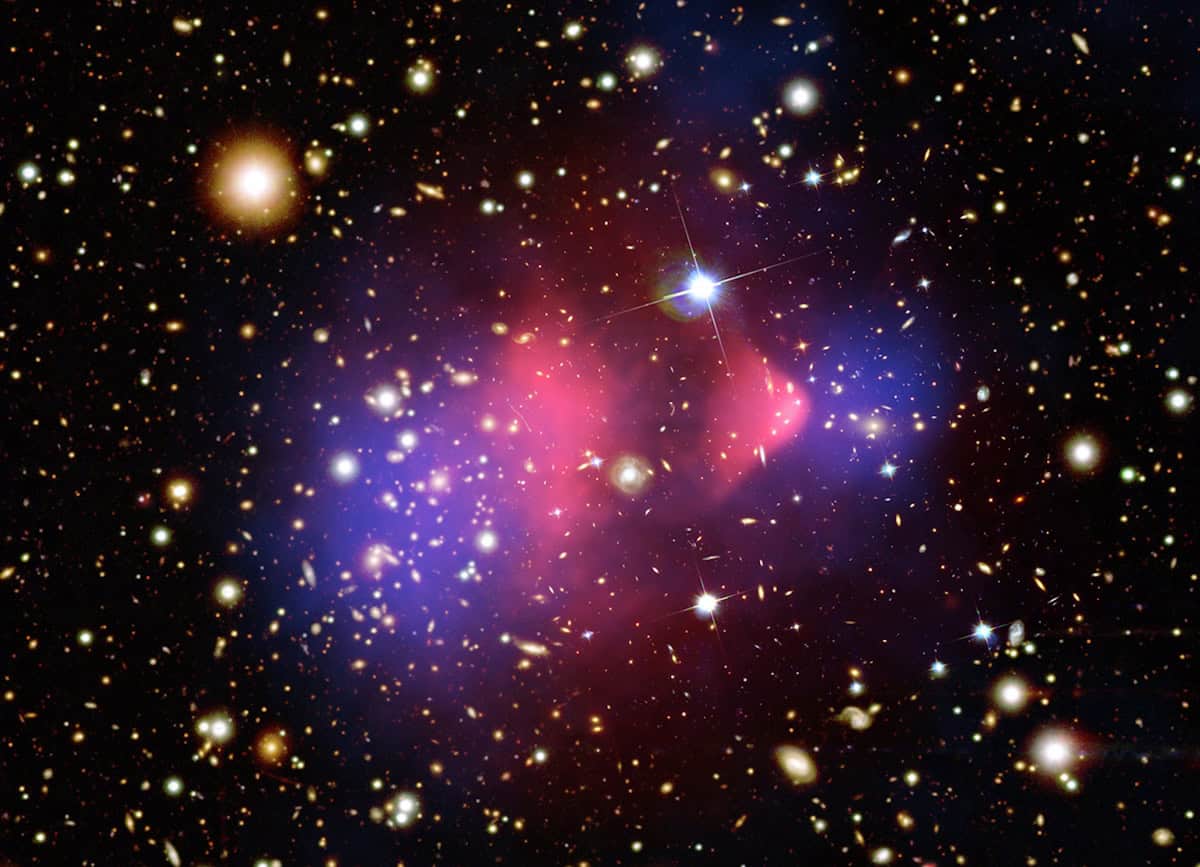
| Bullet Cluster, hot gas in pink, dark matter in blue |
In several previous posts in this blog, I have pointed out that physicists and cosmologists frequently forget the real world and construct theories based on speculations not based on concrete data, observations, or experiments, but only in their imagination. Let’s look at a few examples:
·
Is
physics losing touch with reality? In this post, published in 2017, I used as
examples the various theories about multiverses, the theory of everything, and some
ideas that would make it possible to build a time machine (in principle, but
hardly in practice).
·
Is
physics: science or literature? In this post, published in 2018, I referred to
Freeman Dyson's procedure for extracting energy from stars and the idea that an
advanced civilization could resist the accelerated expansion of the universe.
· Pathological science, wishful science, or ironic science? This post, published in 2023, points out eleven cases of scientific research without experimental basis.
It often happens that these unconfirmed theories,
which therefore should not be considered part of the universally accepted body
of science, rely on one another, which obviously diminishes their credibility.
Let's look at an example:
We know that the existence of dark matter has been proposed to explain the internal
movements of galaxies and the galactic lensing effect. In both cases, applying
Einstein's theory of general relativity, it seems that these galaxies should
contain much more mass than they apparently do. But the existence of dark
matter has not yet been experimentally demonstrated because no particles that
could be part of its composition have been detected, even though it has been
calculated that the total amount of dark matter in the universe should be about
five times greater than that of ordinary matter, which is composed mainly by the
particles we all know: protons, neutrons, electrons, and neutrinos.
The
standard cosmological model assumed (without proof) the existence of dark matter and was adjusted
so that the total amount of matter equaled the sum of ordinary and dark matter:
about 30% of the total needed for the universe to be flat. Furthermore, the
cosmological constant was reintroduced into Einstein's equation (whose effect
was named dark
energy) to add the
remaining 70% and ensure the universe is flat and undergoing accelerating
expansion, as observed in 1998. But the cosmological model does not validate
the existence of dark matter and dark energy, because their existence has been
postulated from the beginning.
 As I mentioned in a 2016 post in this blog (Dark
matter or a new theory),
there is an alternative to the existence of dark matter: Einstein's theory may
not be valid for galaxies. Of course, so far, no one has been able to offer a
convincing alternative theory. I discussed this in a 2025 post: What’s
the matter with dark matter?
As I mentioned in a 2016 post in this blog (Dark
matter or a new theory),
there is an alternative to the existence of dark matter: Einstein's theory may
not be valid for galaxies. Of course, so far, no one has been able to offer a
convincing alternative theory. I discussed this in a 2025 post: What’s
the matter with dark matter?
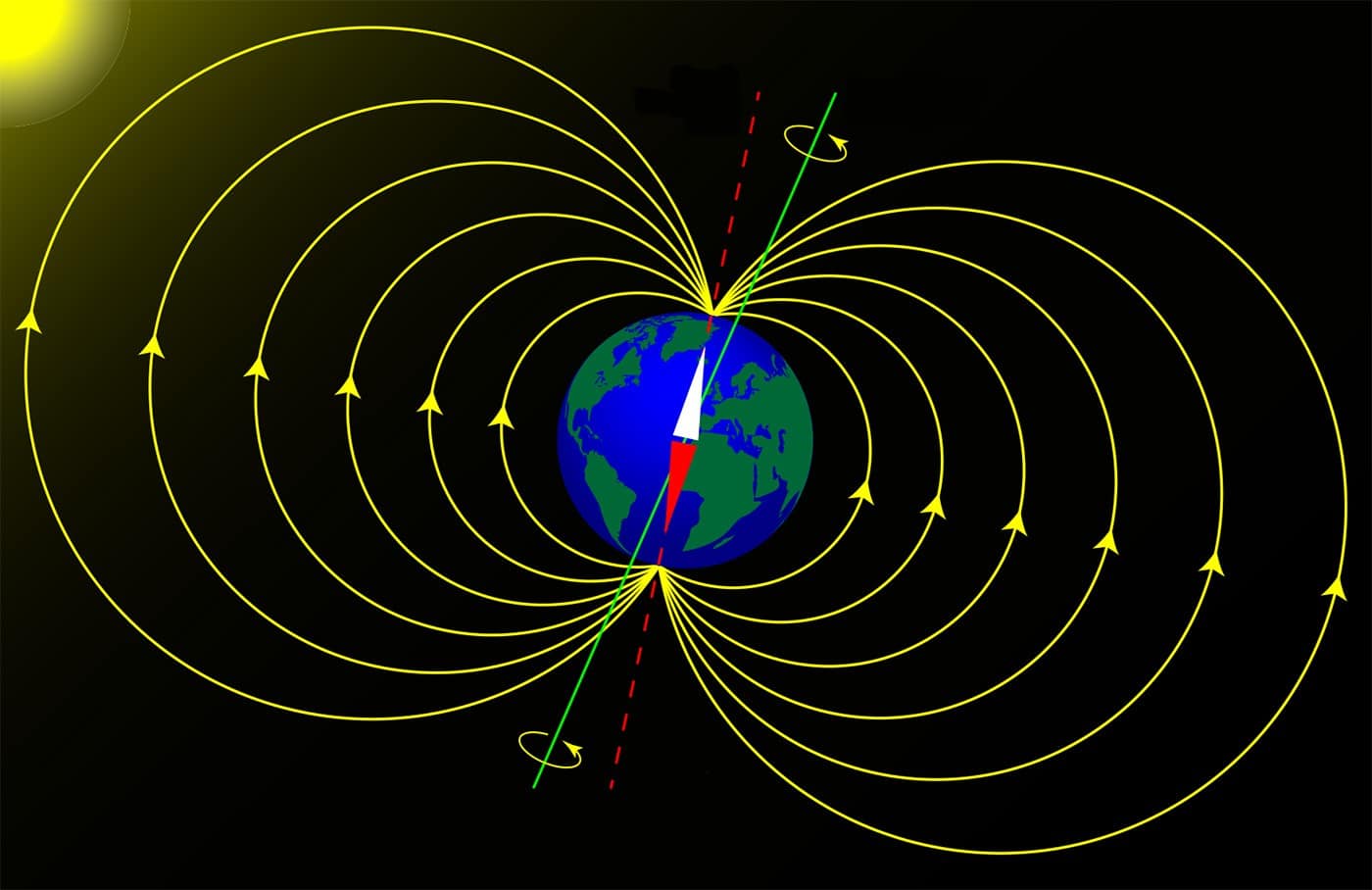
A recent news report echoes a new theory that assumes the existence of dark matter (which, as I've said, is not proven) to draw conclusions about Earth's magnetic field. I'll summarize this new proposal briefly:
·
If
dark matter exists, there must be a large amount of it around Earth.
·
Let's
assume that dark matter has a small amount of electric charge. In that case,
its presence in our vicinity should affect Earth's magnetic field, introducing
a hum that should be detected by the networks of magnetometers we are using to
measure it.
·
The
authors of the aforementioned article, a Chinese team, have looked for this hum
in the measurements of the magnetometers, but haven't found it.
·
From
this, they have deduced an upper limit for the electric charge of the dark
matter surrounding Earth.
Note the chain of hypotheses: a) dark matter
exists, although we cannot detect it; b) it may have some electric charge; c)
but it must have almost nothing, because we cannot detect its effects.
To make matters worse, another
recent news report doubts of the existence of dark matter by applying the
MOND theory, an alternative to Einstein's General Relativity.
Thematic Thread about Standard Cosmology: Previous Next
Manuel Alfonseca
No comments:
Post a Comment